The door of an alpine hut swings open onto warm wood, damp wool and the smell of melted cheese, and for a second every head in the room seems to know exactly what it is doing. You don't. That's fine. Hut etiquette in the Alps is less a code of rules than a rhythm — where to sit, when to order, how to pay, and how to share a bench with strangers who have been walking since dawn. Learn the rhythm and lunch becomes part of the day rather than an interruption to it.
Alpine huts run on two different service models, sometimes both under one roof, and the difference changes everything about how you behave.
Bedienung means table service: you sit, someone comes to you, you order, you eat, and eventually you ask for the bill. This is common in the dining rooms of larger huts and in the stube of a village inn. Selbstbedienung means self-service: you queue at a counter, order, carry your own tray, and clear up after yourself. Plenty of busy huts switch to self-service at lunch and back to table service in the evening.
Look for the signs before you sit down — Selbstbedienung, Bedienung, or a menu board with a queue in front of it. Sitting at a laid table in a self-service hut and waiting patiently will earn you a friendly but firm pointer towards the counter.
Trays stacked by the till, a crowd standing with drinks, a numbered board on the wall: self-service. Place settings and cutlery wrapped in napkins, a waiter weaving between benches: table service. A till by the door and nobody serving at all: order first, pay as you go, find a seat once you have your food.
Hut counters move fast, and the queue behind you has just climbed a thousand metres. Do your reading before you reach the front. Menus are usually on a board above the till, on a laminated sheet by the cutlery, or chalked on a slate by the door.
If you are with a group, one person orders for everyone. Five people ordering separately at a busy counter is a small act of chaos. And if you don't speak German or Italian, a smile plus a point at the board is a complete sentence.
Hut seating is communal by design. Long benches, shared tables and a limited number of places at peak hours mean that "your" table is really just the part of the table you are sitting at. Ask before you sit — Ist hier frei? in German-speaking areas, È libero? in Italian, or a gesture at the empty space and a questioning look, which works everywhere.
Then follow a few small habits. Slide along the bench rather than climbing over people. Keep your pack off the bench, on the floor or on a hook, because the bench is for backsides. Don't build a wall of jackets, poles and maps across the table. If a group of six arrives and there are four of you spread along a bench, shuffle up without being asked — someone will do the same for you tomorrow.
Conversation is optional. A nod and a Grüß Gott or Buongiorno is plenty; nobody expects you to entertain the table. Some of the best information of the day comes from the person beside you, though — a closed path, an approaching storm, a hut that serves better cake two valleys over.
Card readers have spread through the Alps but they have not conquered the high ground. Smaller huts, seasonal huts and anything at the end of a long access road may be cash only, and the machine may be working perfectly until it isn't. Carry a reasonable amount of cash in small notes and coins; it is the single most useful thing in your pack at lunchtime.
Paying works differently depending on where you are. In a self-service hut you usually pay at the till as you order, or at the end when you return your tray. In a table-service room across much of Austria, Germany and Switzerland, you are expected to ask for the bill — Zahlen bitte — rather than wait for it to appear. In Italy, asking for il conto is also normal, though a busy rifugio may simply tell you to settle at the till on the way out. Watch what the next table does; it is always the fastest guide.
For groups, don't ask the hut to split a bill six ways at the height of lunch. One person pays and the group sorts itself out later; it takes thirty seconds instead of five minutes.
Tipping in the Alps is modest and uncomplicated. Round up, add a few coins, or leave a small percentage on a proper restaurant bill in a village. Hand the tip to the person who served you rather than leaving coins scattered on the table, and in German-speaking huts say stimmt so — "that's right" — as you hand over the notes. In Italy, tenga il resto does the same job. Nobody will chase you down the valley for skipping it, but nobody forgets the table that didn't.
Between about noon and two o'clock, every hut within reach of a cable car, a trailhead or a popular pass fills up at once. This is not a crisis, just weather. You can work with it.
Walk earlier and eat at half past eleven, or walk through the rush and eat at two. Eat outside if there is a bench and the weather allows — hut terraces are usually the best room in the building anyway. If you only want a drink and a slice of cake, say so, take it standing, and free the table. And if a queue is forming at the door while you are finishing your coffee, drink it and go. The hut's whole day depends on turning those benches over.
One more thing worth knowing: kitchens close. A hut serving hot food from eleven to two may offer only cold plates and cake afterwards, and some shut entirely between lunch and dinner. Don't arrive at three expecting goulash soup.
None of this is complicated, and none of it is enforced. It is simply the small courtesy that keeps a room of tired, hungry walkers fed and content — and the reason the same hutkeeper will wave you in again next summer.
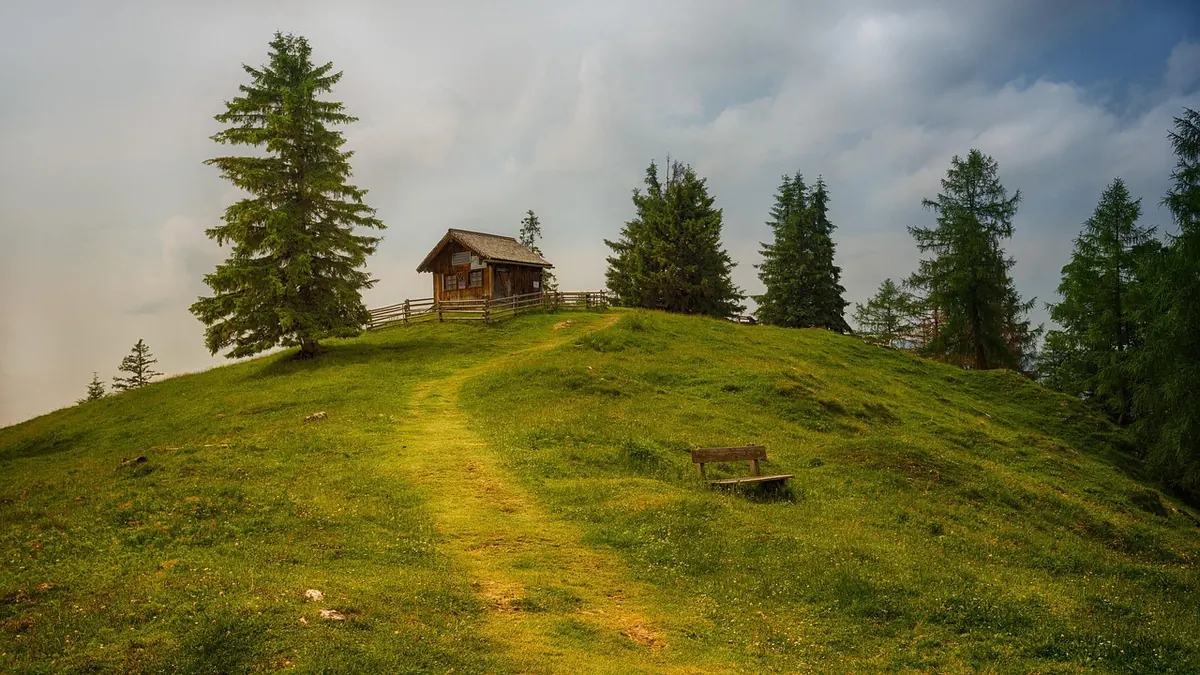
Photo: jplenio / Pixabay