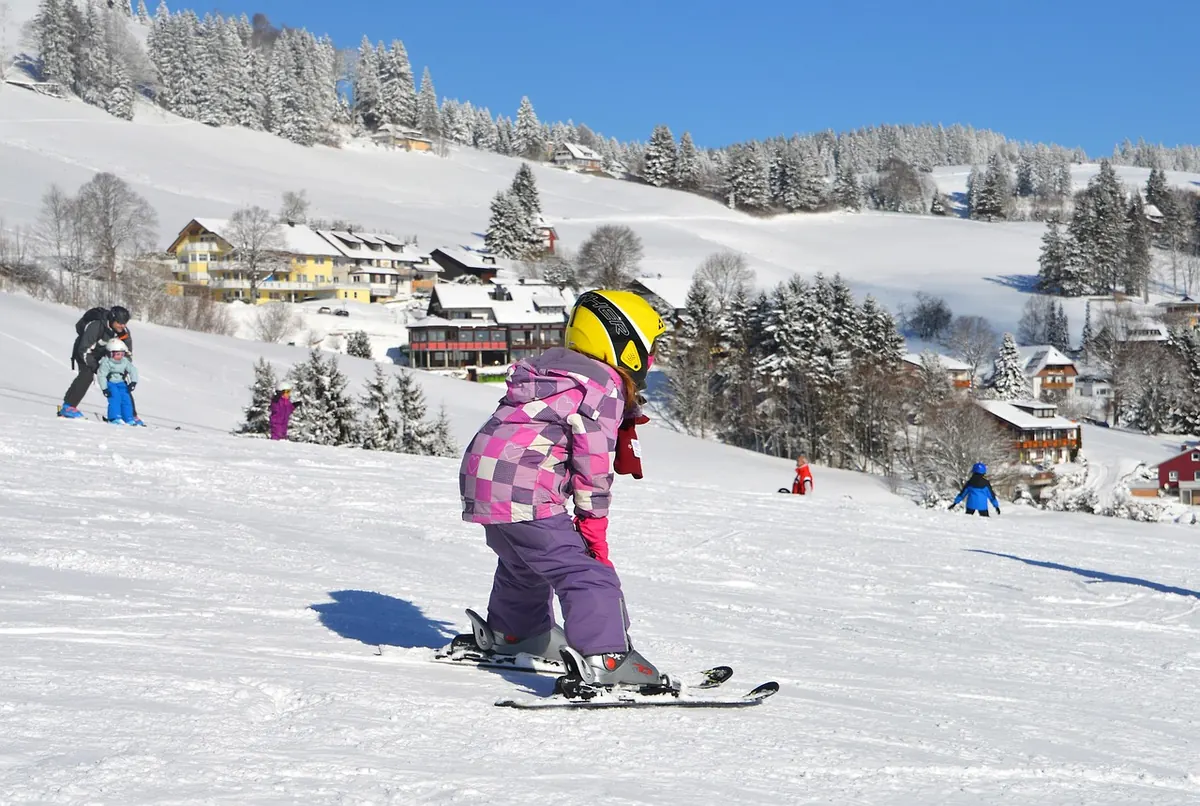
Somewhere between the brochure photograph and the third morning of a tired six-year-old in rented boots, a family ski holiday is made or broken. It is almost never decided by the mountain's reputation. It is decided by small, unglamorous things: how far you walk in ski boots before you clip in, whether ski school meets at nine or half past, whether the grandparent who does not ski has somewhere warm to sit at eleven. Choose well and the week feels easy. Choose badly and you spend it managing people instead of skiing.
Resort marketing sells vertical drop and kilometres of piste. Neither tells you much about a first family trip. What you actually need to know is how much of the mountain is gentle, where the beginner zone sits, and whether it is separated from the traffic of faster skiers.
Pull up the piste map before you book anything and look for three things.
Two more details worth checking: snowmaking on the lower slopes, since the base is where mild weather bites first, and the altitude of the village rather than the peak. A resort with a high summit and a low village can look impressive on paper and still be slush at the bottom in March.
A good ski school gives you back your mornings. A badly matched one gives you a child who cries at the meeting point and a week of private lessons booked in a panic. Ask a short list of questions before you book, by email if the website is vague.
How large are the groups, and how do they split children, by age or by ability? Where exactly is the meeting point, and is it reachable in boots from your hotel? Are lessons half-day or full-day, and is lunch supervised in between? What language will the instructor use? Is a helmet included in the rental package? Is there a fenced area for complete beginners, or do first-timers start on a slope shared with everyone else?
If one child is nervous, one or two private lessons early in the week often work better than five group mornings they dread. And check the small print on the meeting time. A 8:45 start at a point fifteen minutes' walk from your door with two children in boots is not the same proposition as a 9:30 start at the lift next door.
"Ski-in, ski-out" means something different in every resort. Sometimes it means you step off the balcony; sometimes it means a short path, a road crossing and a hundred metres of flat. Flat is fine. Uphill with a child carrying nothing while you carry two pairs of skis is not.
Ask three concrete questions before you book the accommodation. Is there a shuttle, and does it stop at the door or at the end of the street? Where do skis live overnight — a heated boot room, a locker at the lift station, or the back of the car? And how far is the nearest lift on foot, honestly, in boots?
A modest apartment fifty metres from a lift usually beats a beautiful chalet up a hill. Book a locker at the base station for the week if the resort offers them; carrying skis twice a day for six days gets old fast, for adults and children alike.
Almost no family skis bell to bell for a week. Someone gets cold, someone gets a cold, a toddler needs a nap, a teenager would rather be in the pool. Check what the resort offers away from the slopes before you commit.
Useful things to confirm: a public pool, an ice rink, a sledding hill, cleared winter walking paths, a gondola that carries foot passengers to a mountain restaurant, a library or a good café, and a kids' club that takes children for a morning rather than a full day. Note that not every lift allows pedestrians, and some charge for the round trip, so check the resort's own information rather than assuming.
It also helps to have a bad-weather plan in your pocket — an indoor climbing wall, a museum, a long lunch — so a whiteout day does not become an argument.
These are the details that quietly decide whether a morning runs smoothly.
The best family resort is rarely the most famous one. It is the one where the fewest things go wrong.
Travel insurance that covers cancellation, medical costs and rented equipment is worth arranging early. Read the policy carefully, and if any exclusion is unclear, ask the insurer or a broker before you pay.
Do that groundwork and the first morning will feel calm: boots on, skis collected, children delivered to the meeting point on time, and coffee in your hand before the lifts open.
Photo: PIRO4D / Pixabay